
There’s this idea that libraries are quiet, somber places where only eggheads go, but that’s not my experience at all. (As a seeking-to-be published novelist, I love libraries so much that I’ve written about them here, and here, and here, and more.) My neighborhood one reverberates with a wonderful hustle-bustle. Friendly front desk people greet patrons. Tutors tutor within the cubicles. There might be a book sale or a reading group going on in the conference room. Then there’s the music of book pages being turned, the wheels of book carts rolling across carpet as employees can refresh shelves with yet more books. And that’s just inside my humbly majestic library. Beyond the architecture and interior decoration, there’s what it offers via the Internet!
A couple of weeks ago, I started one of their many on-line classes that are offered free. The one I’m taking is on creativity for writers. There were two part to the latest homework.
First was to write a 250-word description of a color. Here’s my homework answer…
I Am Water by da-AL
Dictionaries call me transparent. Yes, I am water, but I’m much more!
As streams, rivers, and oceans, I might be a rainbow of blue and green that shimmers into turquoise. Watch a rivulet on a sidewalk, you’ll see me as gas slicked with ruby, emerald, and sepia. Lapping into waves at the beach or against a child’s bath, I’m spun into milky froth.
Gaze upon my expanse when days or nights are calm, I’ll mirror the sun and sky, or the moon and stars. Let wind brush against me, and I’ll challenge diamonds to glitter with more facets than I do, stars to send out more lashes of brilliance.
Crane your neck and watch me hover far above in the wisps and fists of clouds that’ll invite you to imagine are shaped into animals and more. Close your eyes for me to splash your face with silver droplets of rain. Wait for a very cold day to see me drift white snowflake prisms onto tree tops.
Strain me into a glass and yes, I’ll be dictionary clear. Allow me to sit and I’ll give life to green moss. Dark storm clouds of me can churn earthbound bodies of me into silt.
Whatever my color, I am the force that allows your eyes to see me in all my kaleidoscopic glory. Run your fingers through me, and I escape. Cup your hands to drink me, and I’ll nourish you.
Could it be that I, water, am the color of your soul?
The other exercise our on-line teacher tasked us with was to ponder our workspace and our potential reader. In case it might get you to thinking, whether you’re a writer or simply an admirer of the writing process, here I’ve paraphrased the questions and answered them these ways…
- What could I change about my office or writing space to make it more inviting? I’m enjoying the Valentine’s Day flowers my husband gave me, so maybe I’ll get fragrant fresh flowers for myself in the future!
- 5 things I can do to better understand my reader? a) look at novels like mine on amazon and check profiles of people who review them, b) check out similar books on Goodreads and see what other books their readers also like, c) google what type of person reads my genre, d) once I gather that info, google those sorts of people, e) compile a composite idea of what qualities are most often listed. Now that I’ve done some of that said, over and over I found those who buy women’s commercial literary novels are usually aged 35 to 60, relatively prosperous, and relatively educated.
- What genre would I write in if I could be promised to create respected writing? More women’s literary fiction.
- How do I describe my reader? She’s 40 to 70 years old, middle class or thereabouts, and any combination of American or near-American (my lazy way of not listing most English speaking countries). She’s intelligent and probably has at least a little schooling beyond high school. She’s a lover of creativity, fine art, and fine thoughts. Reading for her is an escape, as well as a way to learn, and to become more compassionate.
- If I could change one thing about my own writerly voice or writing style, what might that be? Why? Am I willing to change if this could make me a better writer? Sure, I’d hone how to best write more for that reader, if I could figure out how and it would help get more readers reading my novels.
This week’s guest blog post is by Sara Allwright, an author/blogger/artist in South Wales. Visit her site for more of her art and writing and there’s this on the book she published…
Door by Sara Allwright
This is where my story began… ‘Door’
Once I came across a derelict cottage, which had been abandoned for several years. I entered the house in awe. The roof was caved in with several beams still intact. The outside growth had penetrated the rooms, ivy weaving through what had been the bathroom. There were numerous layers of wallpaper exposed as it had peeled away with the damp. The staircase had collapsed, with a few treads remaining. I spent many hours in this house, sketching, painting and taking an inordinate number of photographs.
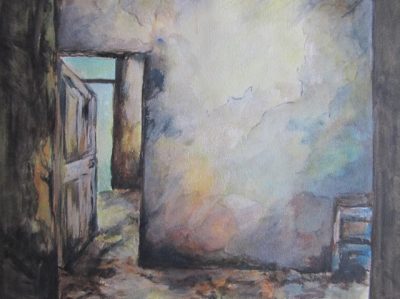
I saw ‘the door’ which separated two living rooms, or what they used to call the living room and the front room. One of the panels from it was missing but I was mesmerised by this door for what reason I don’t know. I had to have it and somehow managed to get it off its hinges, dragging it to my car and taking it home.
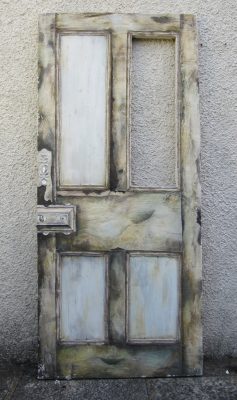
After observing and studying this door, I considered why the panel was absent. There was some reasonable and acceptable conclusion I was sure, which would probably be quite dull and boring, but I felt there was more mystery still to this missing feature.
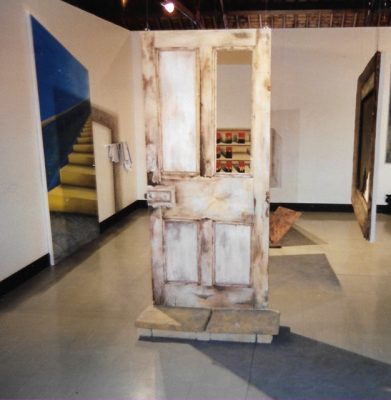
I produced a realistically sized canvas covered in Polyfilla and painted with acrylic medium; I wanted it to be as true to the real object as possible. I wanted the observer to believe it was in fact a real door. An oblong shape was cut out from the canvas to represent the missing panel as this was the main part of the story.
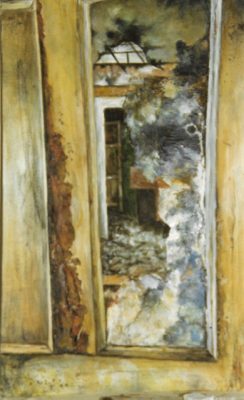
Doors are familiar items which many of us see every day. We do not ordinarily take much notice of or think about them much. They are, however, fundamental items made for a specific purpose. They can also serve as symbols of expression.
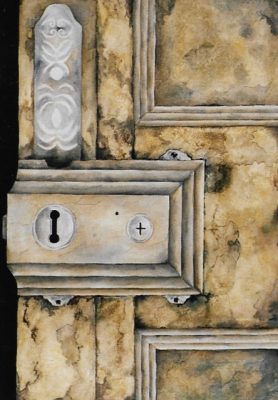
We go out of external doors to face the rest of the world and leave the safety of our home. We come through the door to find ourselves in familiar surroundings and to shut out the rest of the world.
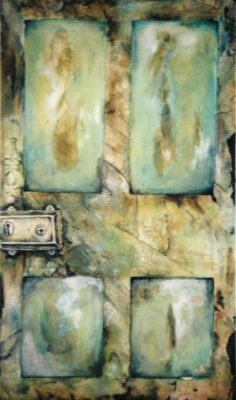
Internal doors allow us to leave and enter different rooms. They both serve to bring a ‘space’ of a room or that of a street to an end or to a beginning. At times the door is closed and securely locked; at others, it is open – maybe just slightly ajar, or half open (or half-closed) or wide open. Doors can usher in a world of sociability or solitude.
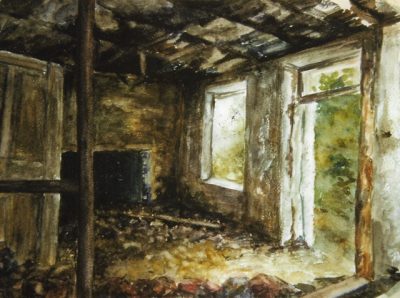
A door can imply much opposition: open or closed, enter or exit, safety or exposure to danger, freedom, or entrapment, locked or unlocked – the list is endless. I wanted to explore these oppositions with the door as my vehicle. The missing panel added another dimension or question to these predicaments or oppositions. The missing panel could provide a means of escape if a person was trapped inside, or it could offer penetration from the outside in, despite the door being securely locked. The missing panel can offer the outsider a glimpse of what may be occurring inside, but if inside it could reveal to you the life that is freely happening outside and far beyond. Is this door with the missing panel a means of escape or entrapment, or a form or means of safety and security?
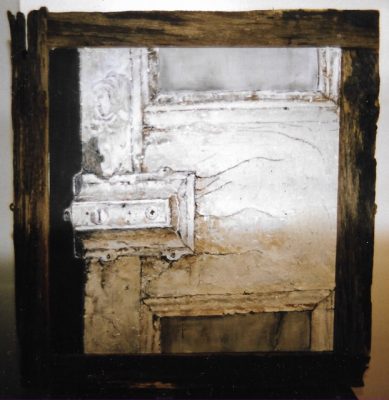
The answers to these questions also depend on whether the door is locked from the inside or from the outside!
Such answers will come entirely from each individual viewer.
My ‘door’, I believe, says a lot about not only my life, but also everyone else’s in some way or another. I think that most people can relate in some way to the references I make to the door.
My painting of a door is my autobiography; that door is my life, my story.
My door and my paintings became my voice.
What would the door with the missing panel mean to you?
Discover more from Happiness Between Tales (and Tails) by da-AL
Subscribe to get the latest posts sent to your email.


I love libraries too and have visited some amazing ones. They are alive with all the books that introduce you to amazing charcters and places! Today’s libraries are active and full of activities. I could live in one!
LikeLiked by 2 people
Me too ♥️ ! Am assuming public libraries in Canada are as plentiful as in US? Maybe not so much in Spain?
LikeLiked by 1 person
Yes, lots of libraries in Canada. my favourite in The Vancouver Public Library. It is built to look like the coliseum. There are fewer libraries in Spain, and the books are in Spanish.
LikeLiked by 1 person
I’ll have to keep the Vancouver one in mind for my next visit!
LikeLiked by 1 person
Your writing is interesting, and the art draws us in.
LikeLiked by 2 people
Thank you Mary! 😊
LikeLiked by 2 people
♥️
LikeLiked by 1 person
Your visit is much appreciated Mary
LikeLike
I too love libraries and am jealous of the energy in yours. Bravo to your folks.
LikeLiked by 2 people
Naively I assumed all were similar. What’s your library like?
LikeLiked by 1 person
Thank you Aaron for your insightful comments. I too left my teaching career to be free from the constraints of the Education system.
My door is now open, open to new experiences with like minded people. If you haven’t already read the book ‘The Poetics of Space’ by Gaston Bachelard, you may find it interesting. It’s a fascinating read…
Thank you again, I really appreciate your thoughts.
LikeLiked by 1 person
Your doors are giving readers and viewers much food for thought Sara!
LikeLiked by 1 person
Thats great to hear!
Thank you da-AL 🚪😁
LikeLiked by 1 person
Reading about your pictures and experiences reminds me of how simple objects we take for granted are often interpreted symbolically. The mundane and routine are actually everything.
(windows, doors, empty/full)
One thing I’ve found doors to be most representative of is exercising one’s perspective/free will. I recently quit my job in healthcare because I realized I was doing more damage through that work and had more impact making art and communicating with other artists and like-minded individuals. So, in many ways, I was a more effective door than a window—or vice versa. Although my company’s intention was to help individuals, the opposite often ended up being the case, or it was harm reduction/damage control rather than actual recovery/healing. So even if my impact through art was minimal, I was, by my approximation, being more of a benefit to society. However, society would only compensate me for one of these two things.
In many ways, our attitudes towards doors are partially determined by our various attachment styles—i.e., some individuals will walk away at the first sign of trouble, while some stay until the end. I frequently look at things from the outside and try to see what it can tell me about behaviors. Is the door broken or window busted? Have people been trying to get out but can’t for some reason? Or like me, they may be caught up in the guilt of staying, that they’ve tried leaving but the door was stuck/glass broken. What about everything outside of it? It’s possible to see burnt husks of houses with doors and windows intact, which to me is representative of capitalism. It’s more important to keep people inside and second-guessing, even if it costs the building and everyone inside it.
LikeLiked by 2 people
You’ve given me even more ways to consider doors Aaron! Thanks much
LikeLiked by 2 people