

How do you make sense of your place in the world? Coming from a mixed-culture family that lived on-the-move, that was heavy on gender inequality, and that didn’t mix with others, writing (click her for more about my books) and reading were my first ways of trying to figure things out.
As the years roll by, just when I think I understand myself, I realize I’m still more complicated. It’s taken a while to accept that my only clear mainstays are that I’m still averse to being pigeonholed, much less commodified. Also, I’ve always believed that compassion is more than ‘niceness.’ It’s how we’ve come this far and we need more of it to thrive further.
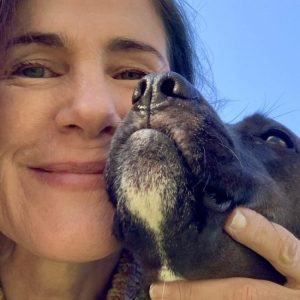
Today’s guest post is by blogger Marco M. Pardi. An avid traveler, he was born in Rome and raised in the United States. In addition to working in various federal positions for 30 years, he taught college for 22+ years. Given his broad range of life experiences, he’s shares with us some deeper ways to consider who we really are. Marco calls this photo of him with his dog, “Being”…
Identity by Marco M. Pardi
I am. Sub-atomic. On a speck of dust at the fringe of one of countless billions of galaxies. I am. Now a particle, now a wave. A passing thought in the Mind we call the Universe, what some call YAHWEH, JEHOVAH, ALLAH, ATMAN, TATONKA, GOD, et al. Perhaps planned, briefly incarnate, then perhaps a memory, soon forgotten.
I incarnated in Rome, Italy to a woman who, to Americans, “looked Italian” and a father who “didn’t look Italian”. I am a near clone of my father. I say to Americans because, to this day Americans seem to still have only images of Southern Italians and Sicilians. In defense of these Americans one of my grandmothers was from England, the other from Scotland. I have always looked “Anglo”.
Coming to the U.S. just after WWII my mother insisted I learn to speak English (American) perfectly to avoid being discriminated against. I did pretty well. But there was one characteristic of me I couldn’t change, at least not as a child: My name. And so, I was an outlier. Accepting that identity shaped my choices of associates, all outliers themselves through crippling illnesses, distinctly foreign heritage, “racial” or religious affiliation, or economic circumstances.
But from my very earliest encounters I found my deepest connections: non-humans. Dogs didn’t call me WOP or Dago, as did the “normal” American kids almost every day. Horses did not make fun of my name. Birds perched near me and sang their calls, unmindful of whether I understood their language; just knowing I got their message. Almost immediately, without effort, understanding developed and soon manifested both ways. Soon other humans, those who noticed, said I “had a way with animals”.
Coming back to college after spending most of the 1960s in the military I didn’t know much about ethology, much less where to go in order to major in it. So, I collected degrees in Anthropology. I was not entirely surprised when I encountered opposition to my position that humans could be studied in the very same way we study other primates. But I persevered in studying how and why individual people identify themselves as they do. And how that is manifested in their treatment of others.
Of course, the standard dogma is that culture, as transmitted through one’s significant others, has the primary role in forming self identity. While that is undeniable, it is also sad.
It is sad because it depends largely, if not entirely upon external impressions. And we know from the rampant hardening of tribalism in the United States that external impressions, especially when communicated through social media channels, are increasingly composed in short hand; “memes”, “tropes” and similar devices that are designed to elicit reaction, not measured thought. As a society we have learned from Joseph Goebbels, the Minister of Propaganda under Adolf Hitler, that a message heard or read or seen often enough instills in the recipient a sense of utter and complete truth.
We need look no further than the effect of social media on pre-teens and early teens. The incidence of self-harm, culminating in suicide is growing at an alarming rate. And, while body image is forefront, devastating attacks include those on personhood. Of course, there are those who survive these attacks. My family, even some teachers, attempted to convince me I was unintelligent – to put it nicely, and I should aspire to one day being a professional athlete. I did not fight them; I simply ignored them since I somehow knew better. And, I found acceptance and community among non-humans, dogs, horses, even wildlife.
Several Native American cultures institutionalized the “Vision Quest” into the maturation of adolescents. An experience of finding one’s unique identity. Several Southeast Asian cultures prescribe a period of Buddhist monasticism for young children, achieving the same self discovery. Here in the West we see a growing interest in horse therapy, not just learning how to ride, learning how to listen and learn from the unconditional acceptance given by horses. Even our prison systems are increasingly adopting programs in which prisoners raise and train dogs as therapy dogs and, unwittingly, are the first beneficiaries of that therapy.
We are individuals, in need of finding ourselves as such, in need of putting the opinions of others in proper perspective.
I am.
Is it important for you to have a clear sense of identity?
Discover more from Happiness Between Tales (and Tails) by da-AL
Subscribe to get the latest posts sent to your email.


BUONA GIORNATA
LikeLiked by 1 person
da-AL and Marco, thank you for this. I, too, am a person who feels deeply connected to animals, and have always recognized that I am an animal myself. There is so much beauty in the natural world and it sustains me- though it can also break my heart. Reading, writing, art, and connecting with kind souls are also imperative.
LikeLiked by 1 person
Sustain and heartbreak. Well stated, Lori. when we risk feeling we can get either or both
LikeLike
Thank you, Lori. I feel much kindness in your writing. Marco
LikeLiked by 1 person
What intrigues me most about animals with reference to identity as that I perceive them of reacting without judgment to the moment of life as to humans, who tend to dwell on no longer relevant memories or wild predictions instead. Even a stranger can make up stuff that might not be true with a quick glance of others or their way of talking.
LikeLiked by 1 person
Great insights usfman. I wish I could live as in the moment as my dog does
LikeLike
What a fine read.
For me, it doesn’t matter so much. I’m a citizen of the world. That’s all.
LikeLiked by 1 person
Thanks Bojana – I wish everyone felt the same
LikeLiked by 1 person
Same here.
LikeLiked by 1 person
Thank you, Bojana. You have the ultimate Passport.
LikeLiked by 2 people
🙂
LikeLiked by 1 person
From a mental health point of view, it is very important to have a clear sense of identity. If you don’t know who or what you are, you will always be wandering through life, going from one extreme to another. People who feel grounded and secure have a strong sense of identity.
LikeLiked by 1 person
The feeling of being grounded and secure can be elusive sometimes for me. At those times, I’m all the more grateful for those who are dear & kind, 2 & 4 legged alike, Dawn
LikeLike
Thank you, Dawn. Even as a small child I “knew” myself. And I learned that criticisms and praise can be equally invalid.
LikeLiked by 1 person