
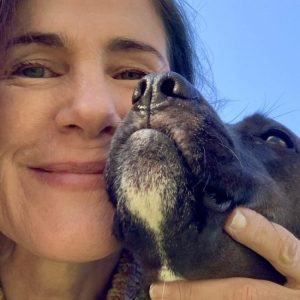

This is the first part of making good on my last post’s promise to bring you along to Norway via this post-vacation form of writing. What follows are photos and a sort of journal that I texted to family and friends along the way.
(Note: all posts about our visit to Norway are here and here and here and here and here and here and here and here and here and here and here and here and here and here.)
Much of why Norway is so incredible is because of — well, so very much! Using their superb mass transit (in our case busses, ferry boats, hiking trails, a rental car, and an airplane), we enjoyed every bit of our three weeks there from the middle of May to early June. We started in Oslo, went on to Kristiansand, Stavanger, Bergen, Balestrand, and ended back in Oslo.
When we left our home in Los Angeles, flowers already perfumed the air, and the sun kissed our short-sleeve clad arms. In contrast, each day in Norway was a panorama of sunny to rainy to warmish to chilly. The entire time, I carried an umbrella and wore multiple layers with a minimum of leggings under jeans and a warm jacket over a long-sleeved shirt. On average, we logged 15,000 steps a day. No wonder we slept well while the sun rose at 4am and faded amid peacock colors at 10pm.
Shortly before the start of our trip, record-breaking wildfires razed huge portions of Los Angeles. Our national politics flamed as well. So that we might catch a break from the mounting bad news, I implored Khashayar, “While we’re away, let’s stay as news-free as we can.”
Once we returned home, jet lag was a piece of cake, compared to grappling with how U.S. politics has turned from bad to worse for all but our wealthiest. For me, visiting Norway was tangible evidence that when citizens agree to care for its entire population, everyone benefits.
Now for the texts and photos…
Part 1 of Oslo…
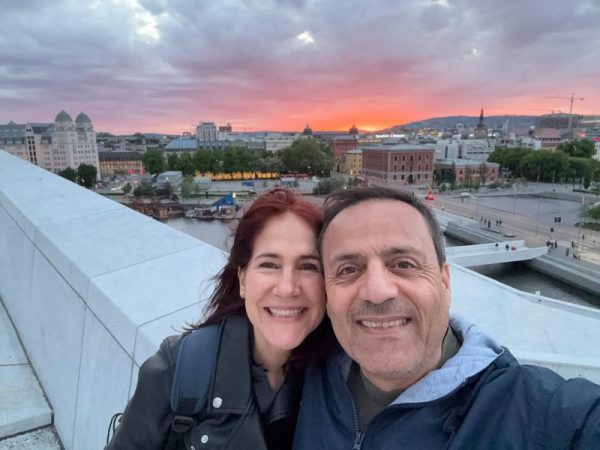
Text: Good morning Norway time! Flight to Oslo went smoothly, though hardly slept. Thai food dinner as soon as we settled in, then went for a beautiful stroll to orient ourselves. Weather is perfect and we slept well. Now we’re up with the birds. Here the sun wakes them at 5am…
Part 2 of Oslo…
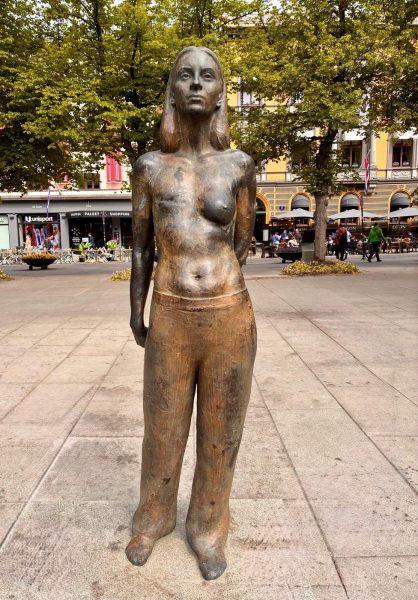
Text: Oslo is where Nobel Peace Prizes are awarded! This very green city showcases an abundance of thought-provoking street sculptures…



An award-winning artist and poet, Jeannie E. Roberts is the Poetry Editor for Halfway Down the Stairs, an online literary magazine.
A Midwesterner with roots in Minnesota and Wisconsin, she’s authored nine books. They include On a Clear Night, I Can Hear My Body Sing (Kelsay Books, 2025), The Ethereal Effect – A Collection of Villanelles (Kelsay Books, 2022); As If Labyrinth – Pandemic Inspired Poems (Kelsay Books, 2021); The Wingspan of Things (Dancing Girl Press & Studio, 2017); Romp and Ceremony (Finishing Line Press, 2017); Beyond Bulrush (Lit Fest Press, 2015); Nature of it All (Finishing Line Press, 2013); Rhyme the Roost! A Collection of Poems and Paintings for Children (Daffydowndilly Press, an imprint of Kelsay Books, 2019); and Let’s Make Faces! (a children’s book dedicated to her son, author-published, 2009). Her work appears in North American and international online magazines, print journals, and anthologies. She is a two-time Best of the Net award nominee.
Here she explores ways to improve your acceptance rate with literary journals and includes tips on the elements of poetry….
The Path to Publication: How to Fulfill the Wish List of Editors by Jeannie E. Roberts
Useful Ways of Improving Your Acceptance Rate with Literary Journals
- Select the publications you believe would be a good fit for your work (research potential literary magazines and publishers via [clmp], Duotrope, EveryWriter, NewPages, Poets&Writers, etc.). Whether your poetry leans toward the human experience, activism or spiritualism, you’ve a better chance of acceptance with publications that coincide with your content.
- You’ve found the publications, now it’s time to submit your writing. Prior to sending it out, have you proofread, double-checked your piece for possible edits and errors? Is your work tiptop for the reader and/or editor of the publication?
- You feel confident about your work and you believe it’s ready for submission. The first step toward acceptance of your work is following the guidelines of the publication to a tee. This may sound like a simple suggestion, but you’d be surprised how many pieces are rejected due to noncompliance.
- Politeness is always appreciated in cover letters to editors. Also, it’s best to refrain from checking in with publications regarding the status of your submission. If the guidelines indicate it will take three months for a reply, resist the itch for an update before the allotted time.
- If you’ve received a rejection email and the editor encourages you to submit your work again, they mean it. No matter how many rejections you’ve received, when the editor continues to extend the invitation to submit your work, keep submitting, don’t give up. Persistence is key.
- Things to keep in mind: it’s best to write about topics that inspire you, but don’t be afraid to use humor, boldness and bravery, and to explore universal topics and contemporary perspectives in your work. In addition, your odds of getting published are better when you submit shorter poems and publishing-friendly work that’s easier to lay out on a page, especially if the publisher uses WordPress.
Tips on the Elements of Poetry
- Include imagery and the senses to elevate your work. When you incorporate sight, smell, hearing, touch, and taste in your writing it engages and transports the reader into your world. For example: “The train whistle evoked the sounds of a past life.” Remember to show (describe) versus tell (give information). For example, instead of: “He was overworked and needed a vacation.” Perhaps rephrase in this way: “His mind grew weary, wandered, where he imagined an ocean.”
- Use tension, suspense, mystery, and unexpected shifts (twists and turning points). Leave questions in the reader’s mind. Pair different images; how do they interact with one another?
- Line breaks and spacing enhance the visual component of your work. As in artwork, white space adds breathing room. Longer lines encourage the reader to accelerate; shorter lines reduce velocity, slow down the pace.
- Language includes control, intentionality, and the economy of words. Try to condense your poem. Avoid words with three or fewer letters and linking words (ex. “like”). Use nouns, strong verbs, and remove versions of “to be” (is, was, were) as they don’t offer anything to the piece. Use strong adjectives and avoid using adverbs. Brevity is best.
Last Words
- Try your hand at writing formal poetry, especially villanelles. In essence, form poems train your brain to condense your work, find solutions using literary minimalism.
- Record your poetry. Play it back on your phone. Listen to its aural quality for a poem is meant to be read aloud. When you read it, does it flow without a hitch? Or do you notice “bumps” or “stops”? If you do, your poem may need revision.
- No matter how seasoned a poet or writer you are, it’s always sensible to revisit resource books, including The Poetry Home Repair Manual by Ted Kooser, A Poetry Handbook by Mary Oliver, Ordinary Genius: A Guide for the Poet Within by Kim Addonizio, The Poet’s Companion: A Guide to the Pleasures of Writing Poetry by Kim Addonizio and Dorianne Laux, The Art of the Poetic Line by James Longenbach, and How to Write a Form Poem: A Guided Tour of 10 Fabulous Forms by Tania Runyan.
Have you found any tips to approach editors?
Discover more from Happiness Between Tales (and Tails) by da-AL
Subscribe to get the latest posts sent to your email.


[…] along the Sognefjord to Balestrand Village. (Note: all posts about our visit to Norway are here and here and here and here and here and here and here and here and here and here and here and […]
LikeLike
[…] (Note: all posts about our visit to Norway are here and here and here and here and here and here and here and here and here and here and here.) […]
LikeLiked by 1 person
[…] all posts about our visit to Norway are here and here and here and here and here and here and here and here and here and here and […]
LikeLiked by 1 person
[…] the rest of Norway — nonstop gorgeous. (Note: all posts about our visit to Norway are here and here and here and here and here and here and here and here and here and here.) As if it wasn’t […]
LikeLike
[…] back to Munch. (Note: all posts about our visit to Norway are here and here and here and here and here and here and here and here and here and […]
LikeLike