

How do you make sense of your place in the world? Coming from a mixed-culture family that lived on-the-move, that was heavy on gender inequality, and that didn’t mix with others, writing (click her for more about my books) and reading were my first ways of trying to figure things out.
As the years roll by, just when I think I understand myself, I realize I’m still more complicated. It’s taken a while to accept that my only clear mainstays are that I’m still averse to being pigeonholed, much less commodified. Also, I’ve always believed that compassion is more than ‘niceness.’ It’s how we’ve come this far and we need more of it to thrive further.
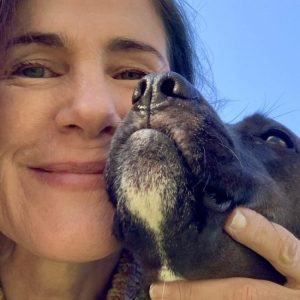
Today’s guest post is by blogger Marco M. Pardi. An avid traveler, he was born in Rome and raised in the United States. In addition to working in various federal positions for 30 years, he taught college for 22+ years. Given his broad range of life experiences, he’s shares with us some deeper ways to consider who we really are. Marco calls this photo of him with his dog, “Being”…
Identity by Marco M. Pardi
I am. Sub-atomic. On a speck of dust at the fringe of one of countless billions of galaxies. I am. Now a particle, now a wave. A passing thought in the Mind we call the Universe, what some call YAHWEH, JEHOVAH, ALLAH, ATMAN, TATONKA, GOD, et al. Perhaps planned, briefly incarnate, then perhaps a memory, soon forgotten.
I incarnated in Rome, Italy to a woman who, to Americans, “looked Italian” and a father who “didn’t look Italian”. I am a near clone of my father. I say to Americans because, to this day Americans seem to still have only images of Southern Italians and Sicilians. In defense of these Americans one of my grandmothers was from England, the other from Scotland. I have always looked “Anglo”.
Coming to the U.S. just after WWII my mother insisted I learn to speak English (American) perfectly to avoid being discriminated against. I did pretty well. But there was one characteristic of me I couldn’t change, at least not as a child: My name. And so, I was an outlier. Accepting that identity shaped my choices of associates, all outliers themselves through crippling illnesses, distinctly foreign heritage, “racial” or religious affiliation, or economic circumstances.
But from my very earliest encounters I found my deepest connections: non-humans. Dogs didn’t call me WOP or Dago, as did the “normal” American kids almost every day. Horses did not make fun of my name. Birds perched near me and sang their calls, unmindful of whether I understood their language; just knowing I got their message. Almost immediately, without effort, understanding developed and soon manifested both ways. Soon other humans, those who noticed, said I “had a way with animals”.
Coming back to college after spending most of the 1960s in the military I didn’t know much about ethology, much less where to go in order to major in it. So, I collected degrees in Anthropology. I was not entirely surprised when I encountered opposition to my position that humans could be studied in the very same way we study other primates. But I persevered in studying how and why individual people identify themselves as they do. And how that is manifested in their treatment of others.
Of course, the standard dogma is that culture, as transmitted through one’s significant others, has the primary role in forming self identity. While that is undeniable, it is also sad.
It is sad because it depends largely, if not entirely upon external impressions. And we know from the rampant hardening of tribalism in the United States that external impressions, especially when communicated through social media channels, are increasingly composed in short hand; “memes”, “tropes” and similar devices that are designed to elicit reaction, not measured thought. As a society we have learned from Joseph Goebbels, the Minister of Propaganda under Adolf Hitler, that a message heard or read or seen often enough instills in the recipient a sense of utter and complete truth.
We need look no further than the effect of social media on pre-teens and early teens. The incidence of self-harm, culminating in suicide is growing at an alarming rate. And, while body image is forefront, devastating attacks include those on personhood. Of course, there are those who survive these attacks. My family, even some teachers, attempted to convince me I was unintelligent – to put it nicely, and I should aspire to one day being a professional athlete. I did not fight them; I simply ignored them since I somehow knew better. And, I found acceptance and community among non-humans, dogs, horses, even wildlife.
Several Native American cultures institutionalized the “Vision Quest” into the maturation of adolescents. An experience of finding one’s unique identity. Several Southeast Asian cultures prescribe a period of Buddhist monasticism for young children, achieving the same self discovery. Here in the West we see a growing interest in horse therapy, not just learning how to ride, learning how to listen and learn from the unconditional acceptance given by horses. Even our prison systems are increasingly adopting programs in which prisoners raise and train dogs as therapy dogs and, unwittingly, are the first beneficiaries of that therapy.
We are individuals, in need of finding ourselves as such, in need of putting the opinions of others in proper perspective.
I am.
Is it important for you to have a clear sense of identity?
Discover more from Happiness Between Tales (and Tails) by da-AL
Subscribe to get the latest posts sent to your email.


I know exactly what Marco went through growing up as I experienced the same but in Australia. Pets and music were my solace. We were made to speak Italian at home and English outside, but I’m truly thankful my parents insisted on this as it gave me an appreciation of the Italian culture later in life. I know a few Americans with Italian heritage but can’t speak a word of Italian and really wish they were taught as children.
As Marco commented, you can change (morph into) almost everything to suit your environment, except your name (in those days) or the Mortadella sandwiches you took to school while others had Vegemite and cheese. Kids can be cruel but this stems from their conditioning/environment they’re from as we’re not born with prejudices. If you’re not strong during this as a child, then you spiral into depression and worse.
I’ve heard of dog therapy especially “Pat Therapy” but horse therapy sounds amazing!
Thank you da-Al for sharing Marco’s history.
LikeLiked by 1 person
My pleasure and thank you for sharing your story as well
LikeLiked by 1 person
My dog is my most trusted companion. He is always there to greet me when I come home with joy that I have rarely experienced from humans except from children.
I have always struggled with my identity. Having as background Russian/Polish grandparents and spending my early years in a French speaking environment while speaking English at home and educated in an English school system, I have always found it both a blessing and challenge to be linked to different cultures. I consider myself mostly anglophone surrounding by a French speaking culture which often makes me feel like an outcast, especially when I encounter people who think that their culture and language is the superior one.
We are sadly much too divided as human beings and so it is no wonder that we often turn to animals for comfort.
LikeLiked by 1 person
I think it would go far towards harmony if we all wised up to the fact that we all need each other whether we agree with everything about each other
LikeLiked by 1 person
Yes, we don’t always have to agree. Listening is good. And so is respect.
LikeLiked by 1 person
I finally got to read this post although tired from cleaning a house I don’t live in anymore for the entire day.
First of all: I agree with you that compassion is much more than being nice, and we desparately need more of it! People who show compassion show respect at the same time, which we need as well much more of, if we ever want to live peacefully together as a mankind.
What Marco writes about identity seems right to me. Animals are much better judges of character, as they don’t judge the outside appearance. We as humans need to get rid of labels of any kind, if we ever want to achieve a united mankind. Therefore, as far as identity goes, I would say “I am me”.
LikeLiked by 1 person
True. We are all well served by recognizing each other as individuals rather than always looking to generalize
LikeLiked by 1 person
To me it seems like compartmentalizing gives people a false sense of security, knowing what things are. At the same time it is very restricting for all parties.
LikeLiked by 1 person
I definitely agree about most social media. It’s really put us back as a civilization.
LikeLiked by 1 person
There’s a lot of good such as blogging but it’s sad how it’s also feeding our weaknesses in so many ways
LikeLiked by 1 person
[…] who grew up in a culturally mixed family. With insights from that experience, he explores identity: how we can make sense of our place in the world. […]
LikeLiked by 1 person
Thanks for linking
LikeLike