
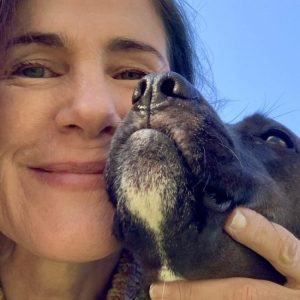

“Everybody’s a teacher if you listen.” — Doris Roberts; actress, author, and philanthropist.
When I posted, “My Abortion Story + Jury Service Pt 2,” I neglected to tell you something important; were it not for Kathy Garland’s courageous and honest blog post that you’ll find below, I might not have published it. (Her account first appeared at PULPMag on Feb. 13, 2020.)
(For an audio version of this post, click H-E-R-E.)
Perhaps you remember Kathy from when she was a prior guest at Happiness Between Tails? (And by the way, here’s another excellent post about the subject contributed by Infidel753.)
Below, she mentions Planned Parenthood. Funding for the organization was signed into law by President Richard Nixon who decreed, “no American woman should be denied access to family planning assistance because of her economic condition.” Planned Parenthood provides far more than abortions. The agency is committed to giving affordable reproductive health care to all genders, all ages, all over the world. They offer sex education, cervical cancer screenings, contraception including vasectomies, and help with sexually transmitted infections.
Kathy has taught English for 25 years, which makes perfect sense, given how she inspires all who read her posts. A wife and mother, she lives in Jacksonville, Florida. Her award-winning work is featured in anthologies and many other places. For info about the three books she’s published and to contact her, check out her personal blog. In addition, she hosts a site to normalize conversations about menopause…
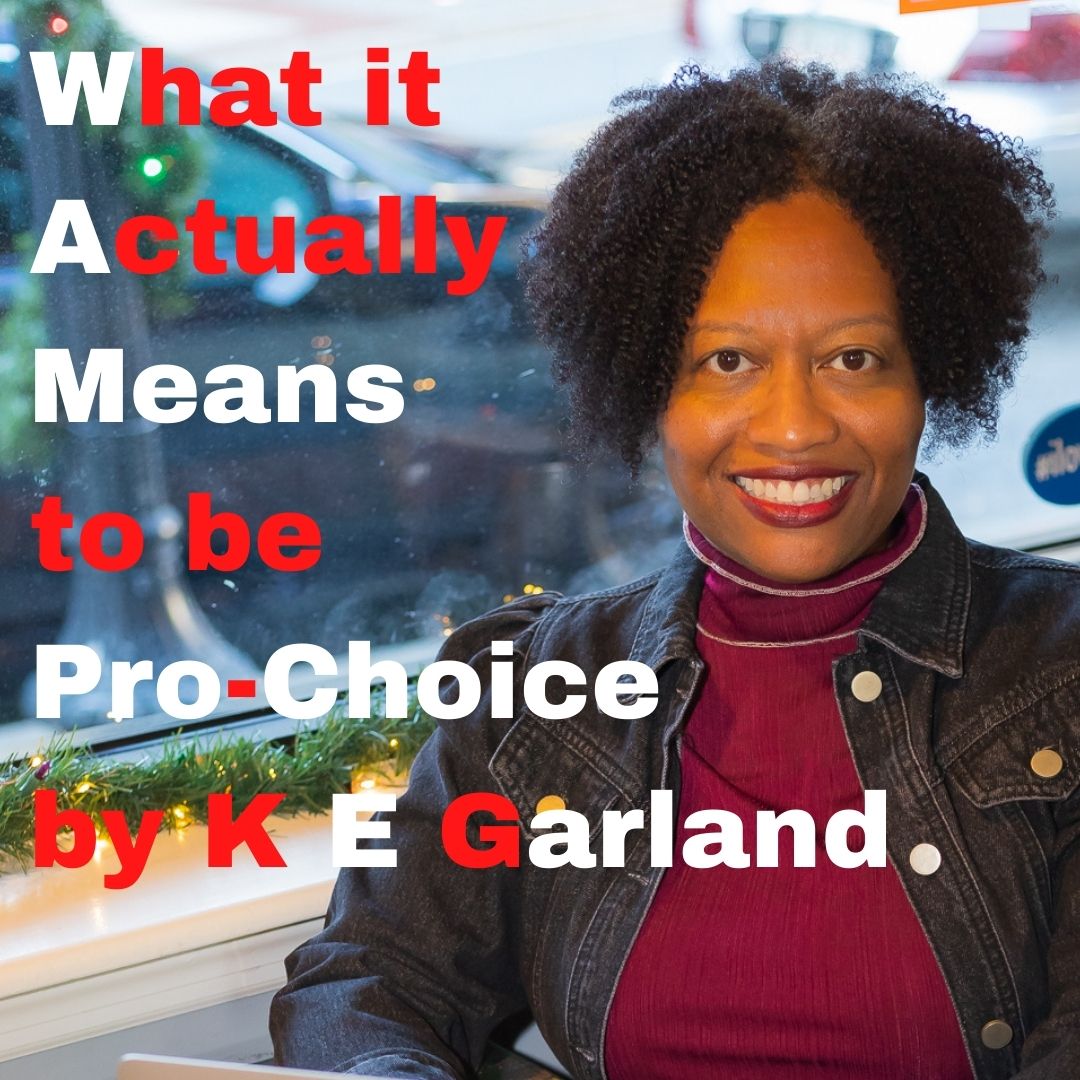
“What it Actually Means to be Pro-Choice” by Kathy Garland
My father taught me about sex when I started my period. We sat on the loveseat, where he explained how menstruation worked, a banana balanced on his thigh. I suspected this was my mother’s idea, although she and I never discussed sex or women’s bodies.
My father explained bleeding meant I could now get pregnant, if I ever had sex, and that it was my responsibility to avoid such circumstances. A condom would do the trick. He pulled one out of his pocket, ripped open the small package, and showed me how to put it on the banana, a mock penis. I suppose he thought it appropriate to cram three separate topics — sex, safe-sex, and periods — into one conversation, because we never revisited either again. But at ten years old, I couldn’t comprehend what fake penises and condoms had to do with the pain in my lower abdomen or the blood that soaked the pad I’d just learned to wear. I wanted the conversation to end so I could finish playing with my dolls.
Six years later, my mother suddenly died from kidney disease. My maternal grandmother was an expert at pushing emotions aside and had advised me to do the same.
“Don’t cry,” she said, “you’ve had your Mama for a long time. Sixteen years is a long time.”
So, I followed her lead and stifled the pain.
My father physically moved on by dating a new woman a week after my mother’s burial. He spent my junior year, courting his newfound love and ignoring me. Taking care of a teenage daughter seemed to be too much for him. The following year, he sent me to live with my grandparents in a small Michigan town called Covert. I was angry. There were more students in my former Chicago high school than in the entire township. I was saddened by how quickly my father discarded me and our relationship. But I’d learned to suppress and ignore all negative emotions. My plan was to keep to myself, graduate, and apply to colleges.
School began the day after Labor Day. It was hard not to be noticed in a class of sixteen seniors, but I tried. Even when I knew the answer, I remained as quiet as possible in English IV, hoping no one would speak to me. In typing class, I hid my nervousness behind intermittent pops of pink Bubble Yum; maybe my aloofness would repel others. Conversations were sparse until I went to computer class. That’s where I met him. He was a junior. He cracked my feigned exterior by making me laugh. He helped me bury my mother’s death. He helped me forget why I was living in Covert in the first place. His name was Eddie.
Our long phone conversations turned into afternoons at Eddie’s home where we sat on his family’s brown sectional and watched movies on their floor model TV. His mother was rarely home. Watching movies turned into tongue kissing and sex, sometimes on the couch or floor, other times in his room.
We became a couple and I’d forgotten about the talk my father and I had seven years prior. I’m not sure what Eddie’s safe sex lessons entailed. By the first day of fall, my period hadn’t come, so I asked his mother what she thought that meant.
She inhaled a long drag of her cigarette, blew a thin, cloudy stream out of the corner of her mouth, looked at me, and said, “Either you late, or you pregnant. And if you pregnant, you need to talk to Eddie.”
I was pregnant.
I knew I could trust my senior English teacher, a brown, petite, no-nonsense lady. Her church dresses and high heels felt like home. The day I confided in her, she asked if I could tell my grandmother. I assured her I could not. Expectations were high in my family, especially my mother’s side. My grandfather had been president of the school board for several years. My grandmother was an important figure at the local civic center. A seventeen-year-old pregnant granddaughter was outside of their equation.
My English teacher neatly wrote the name, Planned Parenthood on a sheet of paper and underneath it, a phone number.
For my initial visit to the clinic, I called into my work-study job and made the 36-mile-drive alone in the car my grandparents had lent me. The appointment was scheduled to ensure I was, indeed, pregnant. Once confirmed, I’d have to return on a separate day for the actual procedure. A nurse told me what I should bring: a change of clothes, socks, pads, and a person to drive me there and back. I also had to commit to a form of birth control. I opted for the pill.
Eddie drove us to the clinic in his mother’s blue Chevy. We sat in the waiting room and watched daytime television with other women of varied ages, until they called my name.
After recovering, we returned to Eddie’s house. His mother had allowed me to hide my car in her garage, so that passersby wouldn’t know I was there. I lay on the brown sofa for several hours, fading in and out of sleep. His mother encouraged me to eat her homemade meatloaf, mashed potatoes, and gravy. The meal warmed and comforted my spirit.
When it was time to leave their home, I hid the paper bag full of antibiotics and pain meds in my backpack and left around eight at night just in time to arrive at my grandparents’ house, as if I’d been working all evening.
Though physically painful, the days following my abortion were liberating. I not only escaped shame, but also teen motherhood. I didn’t want to be a part of the statistically low numbers of adolescent mothers, who never attended or finished college. An abortion ensured I never was.
Thirty years ago, having an abortion offered me a real choice, with no restrictions, followed by a birth control option.
But this isn’t the case in 2020.
In some states, women are currently faced with the strictest abortion regulations to date. Fetal heartbeat laws restrict abortions after six weeks, which is typically the timeframe for confirming a pregnancy and the earliest that abortions can be completed. My teenage self would’ve had no choice but to prepare for birth. Furthermore, states like Missouri that have one abortion clinic, limit access and add stress to an already stressful situation. Also, as it stands now, the national dialogue is centered on extreme cases. Questions like what if a woman is raped or what if the woman might die tend to exaggerate and cloud the idea of choice. While I agree that these are valid reasons for having an abortion, any situation is reasonable.
When we focus on the need to prove rape or death, we create a hierarchy of reasons. When we begin ranking rationale, we also implicitly say, you don’t have the right to choose. The state will choose for you. And that is not pro-choice. That is punishment sanctioned by someone else’s idea of morality.
When I reflect on my senior year in Covert, I know it was best not to bring a baby into my world of anger and resentment. Furthermore, Eddie and I said we’d be together forever, but like many teenage relationships, ours didn’t last. We broke up by the beginning of my second year of college. Although conditions are never perfect, raising a baby with a sixteen-year-old boy in a high-poverty environment, while delaying my education wasn’t ideal. It wasn’t time.
But politicians dismiss stories like mine. Even though a study showed that women who have abortions do so because it would “interfere with their education, work or ability to care for their dependents, or they could not afford a baby at the time,” the current political climate ignores these as valid reasons to terminate a pregnancy.
Governments have successfully reframed the pro-choice narrative to only include situations like rape, incest, or a mother’s impending death. These are not pro-choice examples. These are abortion bans intended to punish women and teenage girls for not having protected sex.
I’m grateful I was able to drive a safe distance to a Planned Parenthood within the state and I’m thankful I didn’t have to involve my grandparents by having them sign an informed consent form, which is current Michigan law. I’m glad I was able to make a choice that was best for me. This procedure allowed me to complete high school, and subsequently college with ease, which in part have contributed to the life I live today as a wife, mother, and professional with a terminal degree. I want the same choice offered for other women, who, for different reasons may become pregnant, but not want to birth a baby. I want our country to return to a true definition of pro-choice, one where women can safely decide the outcome of their situations, without their state’s interference.
To contact K E Garland and for more of her writing, visit her personal blog, or her site that normalizes conversations about menopause.
When were you challenged to make a pivotal decision only you ought to have decided?
Discover more from Happiness Between Tales (and Tails) by da-AL
Subscribe to get the latest posts sent to your email.


Thank you for sharing such an important topic!
LikeLiked by 2 people
Good to see you over here! Thank you so much for reading and commenting ❤
LikeLiked by 2 people
It’s always good to see you here, Hen 🙂
LikeLiked by 1 person
da-Al, my heart breaks for you that you felt it necessary to have abortions. I am not a protester, and I detest the idea of “Christian” anti-abortionist/pro-lifers getting in people’s faces when they are dealing with crises like abortions. But I also do not feel comfortable with the current fad in America by pro-abortionist/pro-choicers, to Shout Your Abortion, as though this decision is something of which to be proud.
When faced with the abortion decision, it requires careful love and personal interactions, not advice from a fellow-blogger or anonymous confrontations at a clinic.
I am opposed to abortion in general and sometimes blog on the issues that are pertinent, but know that I do not hate you nor think you have committed an “unpardonable sin” by having abortions. I only wish you had good relationships that would help you see you that Dr. Seuss’s Horton is correct when he says, “A person’s a person, no matter how small.”
LikeLiked by 2 people
Thanks for visiting & your thoughtful comment, capost2k.
“But I also do not feel comfortable with the current fad in America by pro-abortionist/pro-choicers, to Shout Your Abortion, as though this decision is something of which to be proud.”
My goal is to see each other as one and one and one… not a mass & not “them,” but always “us.” I believe that by each of telling our stories, especially the ones that we should proud of because they were difficult decisions for us to make, reminds everyone that we each have our own road to trod. Shame of everything from menstruation to menopause and all that falls between, the need to not speak up and to hide, is a terrible burden that women have had to bear for far too long.
In the case of abortion, I’m proud that I did my best, proud to support others to live fully by giving them information to make educated decisions, proud to support choice & thereby be proudly pro-choice.
LikeLiked by 1 person
❤
LikeLiked by 1 person
Thank you for having the courage to tell your story. It can’t be easy.
Even with access to capable and sympathetic providers, abortion is obviously a difficult thing to go through. These politicians today who are putting more and more roadblocks in the way are mostly either religious fanatics or are pandering to herds of ignorant voters who are religious fanatics. They are enacting such measures as a form of posturing and displaying their “virtue” and moralistic purity, caring nothing about the real people whose lives are being impacted.
So, I followed her lead and stifled the pain
I was 59 when my mother died and the pain has still been overwhelming. No one should tell you to stifle your feelings in such a situation. I hope you’ve been able to come to terms with it.
LikeLiked by 2 people
I’m glad that you understood this was more than just an “abortion story.” To answer your question, I’ve just come to terms with moving through the pain of my mother’s death in the past seven years. There was a lot of turmoil between age 16 and 42.
I totally agree about religious fanaticism and posturing, especially when the demographics of these procedures are not what people think.
Thank you for reading and commenting ❤
LikeLiked by 2 people
as always, your comments are wise & insightful, Infidel753 — many thanks for always speaking up 🙂
LikeLiked by 1 person
goodness, what an oaf I am — was so distracted with pro-choice rights that I forgot to offer you my heartfelt condolences about your dear mom — you’ve written before that you’re fortunate to have great parents ❤
LikeLiked by 1 person
Do I understand correctly that it is now harder in the US to get an abortion than before?
I remember from my youth that young girls went to the Netherlands to get abortions, because they were most progressive there. Now in Scandinavia every woman can decide, whether she wants to give birth to a baby or not. There is, however a time limit until which an abortion will/can be executed.
Young single mothers don’t have the same stigma here, not if they get an abortion …
LikeLiked by 2 people
Do I understand correctly that it is now harder in the US to get an abortion than before?
In most states governed by the Republican party, it has certainly become harder. That’s most of the southeast and of the deep interior of the US. Michigan, where Kathy apparently lives, is not Republican-controlled but they have a lot of influence.
The religious extremists are declining in numbers, but increasing in militancy, and their dominance within the Republican party gives them substantial power which they have mostly used to attack abortion rights (and gay rights, though they’ve been less successful at that).
LikeLiked by 3 people
thanks for chiming in, Infidel753 — I neglected to add a link to the great guest post you did for Happiness Between Tails — I’m adding it above now. & here is it is too: https://wp.me/p6OZAy-1gzb
LikeLiked by 1 person
Thanks — my guest post was actually in part one.
LikeLiked by 1 person
Thank you for clarifying.
LikeLiked by 1 person
Yes, it is MUCH harder than it was in the past. Legislation in varied states make it challenging to have an abortion for any reason. In some states, it doesn’t matter if you’ve been raped or just made a “mistake.”
LikeLiked by 2 people
One should not have to give a reason at all …
LikeLiked by 3 people
Indeed. It is infuriating that religious fanatics and pandering politicians are trying to stick their noses into such a personal decisions and pass judgment on a woman’s reason for making it.
LikeLiked by 2 people
Most religions, especially Christianity, preach “love thy next” etc., but fanatics are all hate. Jesus was not all hate, he accepted everybody. These people don’t know the situation a woman is in. Instead of judging, they should help, if they can’t mind their own business. They don’t want the baby to be aborted, but they are not interested in, what happens to it after birth, (I am tempted to use strong language here, but I will resist as a guest on this blog).
LikeLiked by 1 person
you are welcome to use all the strong language you like, Birgit lolol
LikeLiked by 1 person
Sadly, you read correctly, Birgit. Moreover, I can’t imagine how horrible (& time wasting when it comes to physical deadlines) it is to have to defend one’s need…
LikeLiked by 1 person
I think if one is too far into the pregnancy it gets dangerous also for the mother. If I remember correctly it is 12 weeks in Scandinavia. But one can decide for abort as soon as one knows about the pregnancy.
LikeLiked by 1 person
The state thinking for you is definitely not Pro-Choice. A woman’s body is her choice and we need to not make an effort but gives her what truly belongs. As a journalist, I have covered some legislations leading to abortion and I was hugely in favor of using my pen pressing the trigger on other people’s shoulders to make an impact since as a reporter was not allowed to make a personal opinion. The sad part was religions trying to dictate for a woman.
LikeLiked by 3 people
That’s exactly right! Religion plays a huge part in legislation; however, it’s ironic that when it comes to making an actual decision, religious women also choose abortions sometime. At any rate, thank you for reading, commenting, and being an advocate for women’s rights!
LikeLiked by 2 people
your thoughtful comment is much appreciated, Vishal. When the needs of women everywhere are tended to, everyone benefits.
LikeLike