
The cooler weather and rain of late, here in Los Angeles, is perfect for staying home to do all the work involved with getting my novels out into the world. (Click here for about my books.) But while I write, the critters around me have other ideas.
My dear doggie is doing her best to sunbathe…

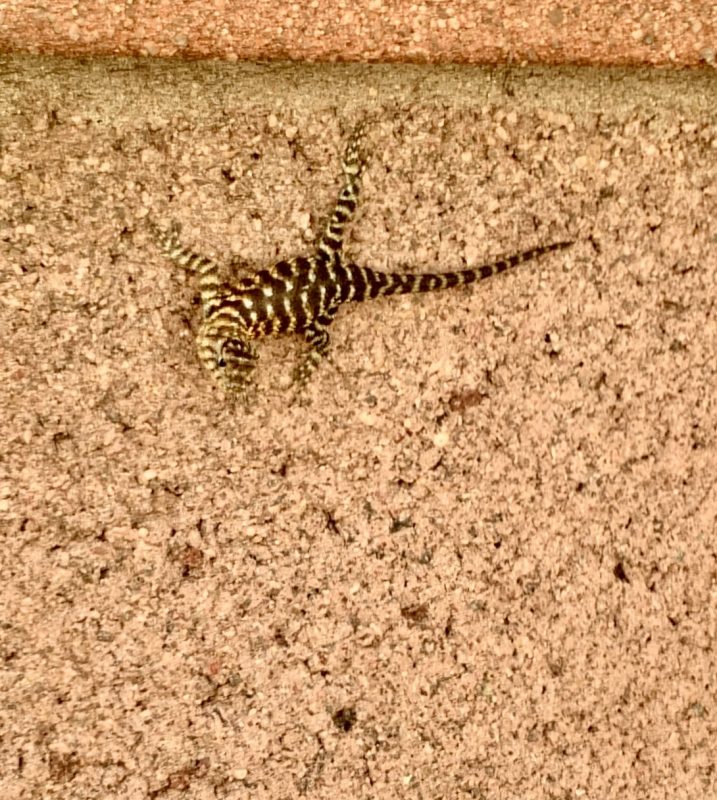
The lizards who share our home are equally eager to catch some rays. This striped one is something new, not the usual gray sort with a blue belly. Do you know what these are called? Google says it’s a banded gecko, but their photo looks completely different from this striking creature…
Norway: Cruising the Magnificent Hardangerfjord
Now let’s go on our next leg of our enchanting visit to Norway! For today’s post, we woke at 5am in Balestrand to catch a bus bound for Norheimsund, 50 miles away. There we caught a boat to cruise up the Hardangerfjord, another of Norway’s jaw dropping fjords. It’s the world’s fifth longest fjord, and Norway‘s second longest fjord.
(Note: all posts about our visit to Norway are here and here and here and here and here and here and here and here and here and here and here and here and here and here and here.)
Along the way, we passed under the impressive Hardanger Bridge…

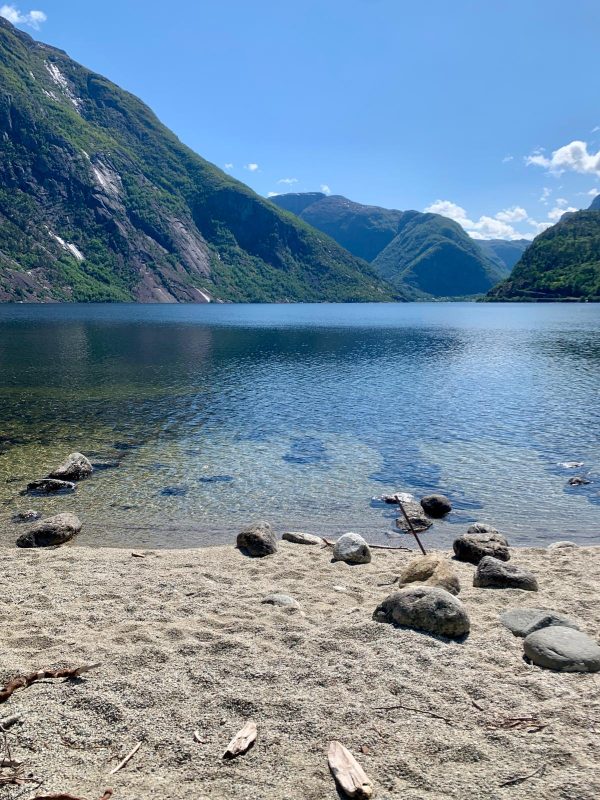
At the head of Hardangerfjord, we disembarked at Eidfjord village, where we picnicked at this tiny sandy beach…
We walked past lush pastures and pretty houses…

We also viewed the Hæreidmoen Iron Age burial field…

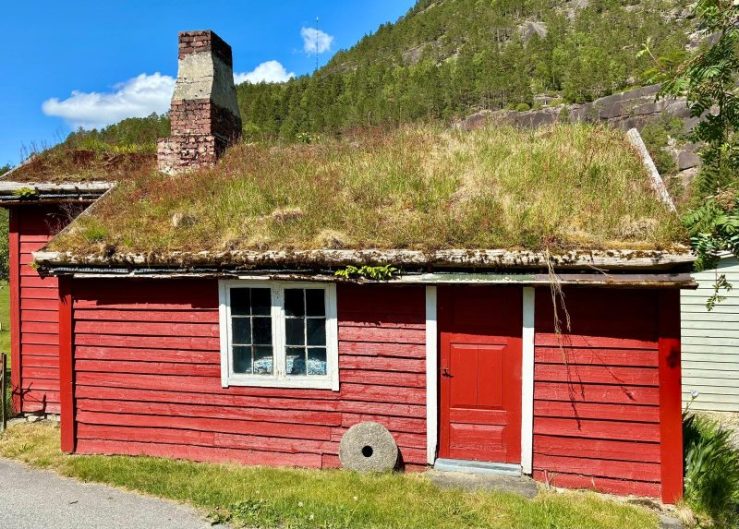
We saw a wonderful example of a traditional home with a sod roof…
We were delighted to spot these wooly families…
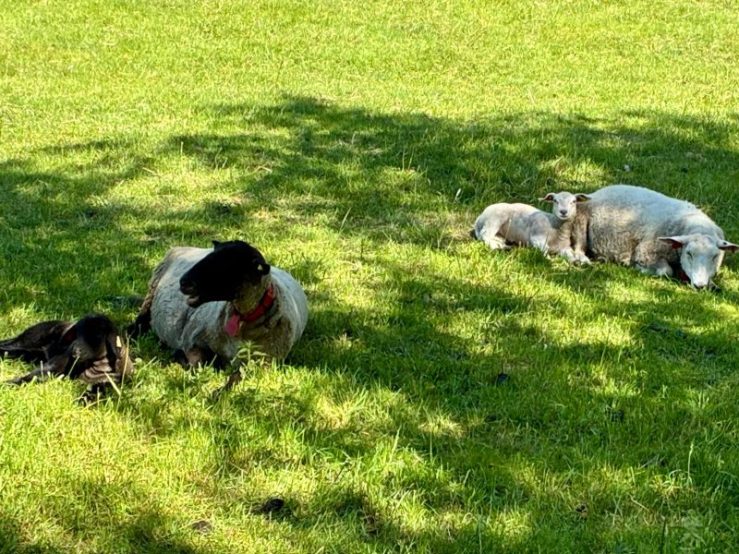
The scenery on the trip back was worth braving the cold and wind!…
Today’s Guest: Shaharee Vyaas, Cryptomathician and Digital Nomad
Shaharee Vyaas blogs and writes from “somewhere between Europe, Central America, and Asia.”
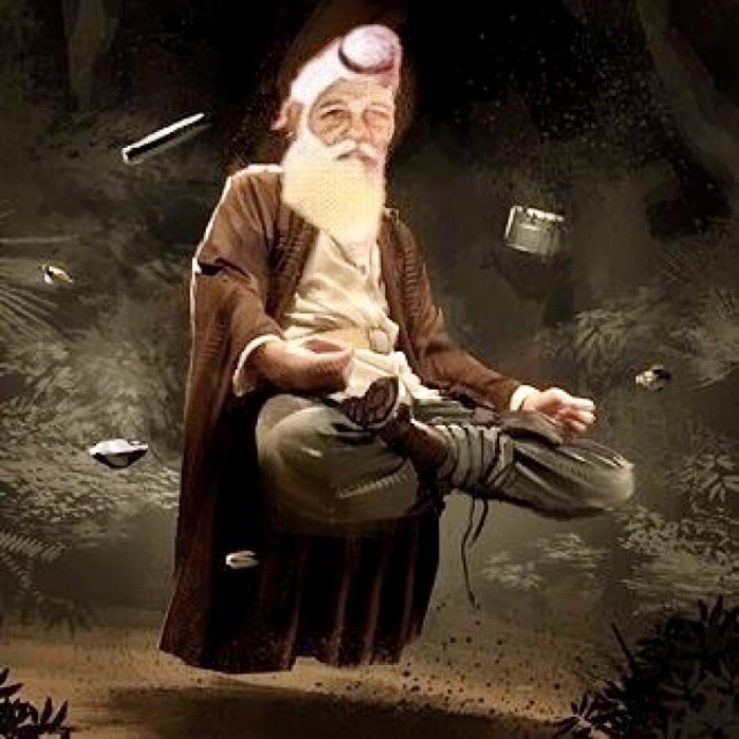
A retired professional soldier, he currently works to, “bring dharma and karma in harmony with each other.” He calls himself “a cryptomathician; someone who’s researching the synergies between science, art, and religion through mathematization.” Check out Shaharee’s site for more about him and his writing.
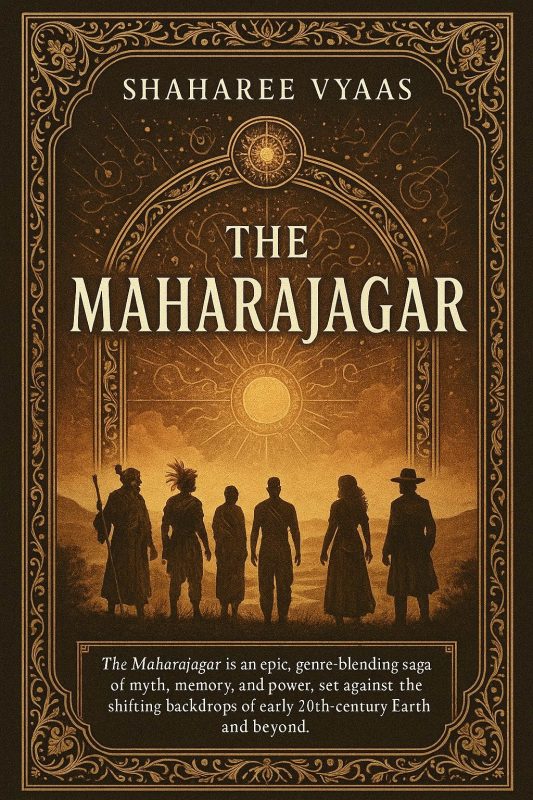
The Maharajagar: an algebraic system concept turned into a novel by Shaharee Vyaas
The Maharajagar is the cryptomathic distillation of an algebraic mythic concept into a novel. The novel is written in the language of shrines, artifacts, and the shifting balance between chaos and memory. At its centre is the Qi’tet, a group of protagonists whose arcs can be read as variables in a recursive equation, each drawn into a struggle where domains interlace and outcomes spiral rather than resolve.
The protagonists—Alec, Minik, Wen, Mahmoud, and Sheeva—emerge first as distinct functions. Alec’s path integrates chaos into continuity; Minik anchors with gravitas and resonance; Wen strips illusions, discerning truth from noise; Mahmoud channels ancestral recursion, translating myth into pattern; and Sheeva, a stabilizer, measures change and keeps the balance. Together they confront not just external forces but the algebra of reality itself, where every action folds back into the Mandala.
Artifacts act as global constants, appearing early as enigmas and only gradually revealing their systemic role. The Cintamani, encountered as a luminous stone of shifting brilliance, is first taken for a simple power dynamo. But as the group journeys further, it reveals itself as a global chaos attractor, a kernel that both destabilizes and illuminates. Its presence causes shrines to fluctuate, pushing each domain—Materium, Labyrinth, Dream Web, and Void—toward thresholds of collapse. To touch the Cintamani is to risk unbinding memory itself, yet it is also the only way to perceive the equations that underpin the world.
In parallel, the Phoenix Crown manifests in the early stages not as a crown at all but as the recurring vision of a Firebird. This bird of flame crosses dreams, rituals, and landscapes in the first three parts, its universal significance overlooked by the protagonists. They see it as omen, protector, or passing marvel, but not as a global unifying emblem. Only later do they understand that the Firebird is the Phoenix Crown itself, a stabilizer of shrines and restorer of Memory against Chaos. As the chaos attractor destabilizes, the firebird-crown re-anchors, showing that every system of collapse holds its renewal in potential.
These artifacts weave directly into the shrines, which serve as nodal invariants across domains. The Earth shrine grounds continuity; Water flows with ancestral memory; Fire burns as trial and rebirth; Air circulates thought and connection; Ether binds what otherwise dissolves. The Cintamani excites them into crisis, while the Phoenix Crown restores their balance. Each protagonist aligns with a shrine: Mahmoud with Earth and ancestral rituals, Sheeva with Water’s stabilizing flow, Wen with Ether’s clarity, Minik with Fire’s gravitas, and Alec with Air’s spiralling integration.
Among these forces, Goorialla, the Rainbow Serpent, coils as both guardian and test. It represents the Dreaming continuity that underlies all shrines, the current that cannot be reduced to equations yet sustains them. To meet Goorialla is to recognize that memory is not only human but planetary, that shrines are not inert structures but expressions of an ongoing Dreaming. Where the Cintamani destabilizes and the Phoenix Crown restores, Goorialla remembers, ensuring that even the Spiral remains tethered to deeper song lines.
Opposite the Qi’tet stands Long Feng, Wen’s cousin and the inversion of the system. Where the Qi’tet integrates, Long Feng fragments; where the Firebird signals rebirth, he seeks dissolution. He is the negative solution, a reminder that every system carries its own inversion.
As other figures enter—the twins Absalom and Esther, who begin as paired vectors before diverging; Chanelle, the healer; R’luh the cryptomancer, Merlin and Glaucus the prophetic dreamers; and Quaie Bock, the corrective constant—they reinforce that this is not a story of linear victory, but of spirals. Artifacts, shrines, protagonists, and dreaming beings interact as terms in an open equation, always recalibrating.
In the end, The Maharajagar is less a closed tale than a proof in motion: chaos as input, memory as transformation, shrines as invariants, and continuity as the Spiral’s emergent solution.
Do you find travel (or even just your local environment) is a major source of inspiration for your writing? Share your favorite source below!
Discover more from Happiness Between Tales (and Tails) by da-AL
Subscribe to get the latest posts sent to your email.


Delightful Post Thanks
LikeLiked by 1 person
Your sunbathing doggie looks so cute in that T-shirt. 😀 The lizard, not as much – I’d be freaked out by that! 😲
Thank you for sharing more of your Norwegian tour, da-AL. Such beautiful scenery! 😍 I was intrigued by the sod roof, which, apparently, is common in Scandinavia. Sturdy, and more economical! 👌
The concept of a cryptomathician is interesting, and the story sounds magically ethereal. 💫
LikeLiked by 2 people
thank you for all your compliments and for reading the post so thoroughly- you are a sweetie indeed, Debbie!
LikeLiked by 1 person
You’re very welcome, da-AL. 😀 I am always thorough. It’s a Teutonic trait. 😉
LikeLike
Gaining inspiration through traveling can be compared to some digestive process. First you consume and then render it into an experience that allows you to grow as a person. I usually write only about places I’ve visited and then condense these experiences to the needs of the narrative. I also have a tendency to read novels that have a setting that matches my location. It boosts the storyline I’m working at, because writing without reading is to me as infertile reading without writing. It’s a process that makes you grow as a person.
LikeLiked by 1 person
Shaharee – so true – travel, as well as reading and writing – all compliment each other
LikeLiked by 1 person
**A captivating journey! From LA’s vibrant writing scene to the serene magic of Norway’s Hardangerfjord, the blend of real landscapes with the algebraic myth of *The Maharajagar* sounds beautifully imaginative. Shaharee Vyaas offers a truly unique literary experience.**
LikeLiked by 1 person
thank you, Safia!
LikeLike
Norway looks incredibly beautiful, da-AL
LikeLiked by 2 people
It is, Mary!
LikeLiked by 1 person