
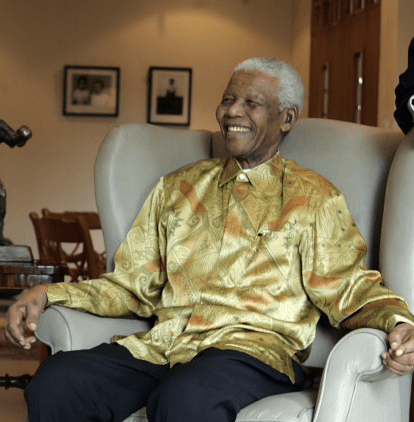
After enduring 27 years in South African jail for speaking out against racism, revolutionary-politician-philanthropist Nelson Mandela (South African, July 18, 1918 – Dec. 5, 2013) went on to serve as South Africa’s most internationally acclaimed president. Nowadays, many there refer to him as ‘Father of the Nation.’ (By the way, check out this gorgeous quotation that’s wrongly attributed to him.)

Each time I read his famous quotes about having confidence and being brave, I am reminded of the times I’ve shocked myself by seeing how sneaky my fear of success can be. As a kid, I worried that setting myself apart would invite criticism, jealousy, and ostracism.
Those fears persist, but in ways that I have to be extra vigilant to detect. Anyone who is thoughtful and who puts their heart into their work knows that insensitive and sometimes even ill-willed people exist within all realms of one’s life. It’s not always easy to not give a damn, but somehow I must slog through the self-doubts that others trigger in me and that I can supply in generous quantities on my own.
Fortunately, at times I know I’m good, and that there are great people all around me. Good and bad and alternating, Mandela is right to point that that being our best selves benefits everyone.
As an adult, only an hour after I had won an Emmy Award, a stranger asked me how the honor felt. My reply was so awkward that he went so far as to remind me that I had indeed won it. Months afterward, telling people about it continued to be a confusing affair.
Now when I’m frustrated by not accomplishing my goals as quickly as I’d like, I remind myself of Mandela’s wise encouragement. Sometimes I need to be patient. Other times, I see that I need a major confidence overhaul, which at first glance appears impossible to achieve. That can involve looking for examples of other people doing what I’d like to do. Talking with people who’s judgment I trust also helps. Allowing myself to be uncomfortable with the process is crucial. Patience is always rewarded.
Do you ever get in your own way?
Today’s guest blog post…
…is by blogger/author Jacqui Murray. Visit her site and you’ll be impressed by the range of what she writes about, whether fiction or nonfiction. Today she shares some of her research notes for her prehistoric fiction saga, Man vs. Nature which explores seminal events in man’s evolution one trilogy at a time…

What Was Neanderthal Clothing Like by Jacqui Murray
Neanderthal wore hides. These were much more advanced than a Mammoth skin with a hole cut in it for the head that hung over the body, but not as sophisticated as the snugly stitched clothes made by Homo sapiens (modern man) who came out of Africa and settled in the cold Eurasian climates. Each Neanderthal required five large hides every few years for their wraps, capes, and foot coverings. That would take 20-80 solid hours of processing.
Here are some notes:
Clothing
- Cold weather, the typical Neanderthal climate, required fitted clothing and foot coverings to keep from freezing in frigid temperatures with often deep snow.
- Neanderthals were skilled enough with scrapers to clean bits of flesh from buffalo, deer, mammoth, elephant and other hides. They did this by holding the skin in their mouth like a third hand, as some current populations do, freeing both hands for cleaning, scraping, and cutting. Once cleaned, they were soaked maybe with added wood ash, maybe in rivers or lakes or pits.
- A bone awl was used to poke holes in the hide where the needle could slip cordage through and lace together pieces into a loose-fitting garment. “Loose” is our term, but to them, a much snugger fit than without the stitching.
- Preparing one deer skin takes about a day. They could preserve them with salt or smoke, and by tanning.
- The thread for lacing was made from bark or root. Neanderthals would use the fibrous layer of tissue just beneath the bark, soak the fibers to separate, soften, and then twist them into cordage.
Carry bag
- These were made from the cleaned organs of large animals or hide scraps. It is likely they wore carry bags over their shoulders–large to carry what they foraged, eggs, plant food, spare hides, and other items.
Jewelry
Neanderthals did wear what we consider necklaces or bracelets made of feathers, shells, pebbles, and eagle talons strung on a cord. Why they wore jewelry, we don’t know, maybe for body adornment, but possibly to identify a tribe or for symbolic purposes. No species prior to Neanderthals had practiced this.
- It is unclear how they drilled the holes in the articles, maybe with the same awl they used to create lacing holes in clothing.
- Researchers from the Max Planck Institute found that Neanderthals manufactured nearly identical doughnut-shaped, ostrich-shell beads, often with the same thickness and diameter. These may have been worn to communicate symbolic messages, the way we might wear a wedding ring, to indicate something about social status, wealth, or position in society. What stood out to researchers was how similar they were across different areas. It suggests a coherent social network spanning a large distance, tying the south of the continent to the east. This could be related to the geometric symbols found in caves that also were similar across a large geographic area though there is no proof of that.
![]() Body painting
Body painting
Body painting may have been the earliest form of art, before handprints on cave walls or painted stones. Neanderthals had paint kits for coloring rocks, hides, or their bodies. It consisted of items like ground red ochre, manganese, special rocks, crushed bones that had been heated to extract the marrow oils, ground charcoal, and a fluid such as water or urine. They used a slim bone to apply the resulting mixture to whatever object or person was the end product. The preparation of the paint mixture required at least a basic understanding of chemistry since the materials often had to be heated in very specific ways to get the desired results.
Assembling all of this would have required quite a bit of planning as these materials were not available in the immediate vicinity.
Discover more from Happiness Between Tales (and Tails) by da-AL
Subscribe to get the latest posts sent to your email.


Great post!
LikeLiked by 2 people
Thank you Chris
LikeLiked by 1 person
Doing your best is sometimes just not enough when nobody pays attention. I don’t feel like imitating Dali and go around on fifth avenue with a bell and ring it every time people weren’t paying attention to him.
LikeLiked by 2 people
I love that story about Dali 😝 hoping he was simply doing performance art?
LikeLike
No, he was dead serious about it.
LikeLiked by 1 person
[…] Marianne Williamson is proud of however zillion times it’s attributed to Nelson Mandela (click here to read a post I wrote about him) — reminds me of how sneaky my fear of success can […]
LikeLiked by 1 person
[…] which surely Williamson is proud of however zillion times it’s attributed to Nelson Mandela (more about him H-E-R-E) — reminds me of how sneaky my fear of success can be. As a kid, I worried that setting myself […]
LikeLiked by 1 person
When I’m able to override my creative insecurities, write something unconventional, and “put it out there,” I feel I deserve an award for just that. For me, sometimes that’s the hardest part of the creative process.
LikeLiked by 2 people