



In This Week’s Dispatch:
- Reading for Life: A review of Becca Levy’s Breaking the Age Code and how positive beliefs act as a powerful life-writing tool.
- The Writer’s Eye: Travel photography and notes on finding unique setting inspiration while exploring the Norwegian fjords and ancient stave churches.
- The Creative Process: Guest post from Nurse Will on finding practical strategies for focusing and executive function—essential skills for both parenting and the writing craft.
Every since I learned to count in first grade, the passage of time frightens me. The ages my parents would be when I was an ‘ancient’ twenty were so scary I cried myself to sleep. At six years old, TV showed me that the graceful Olympic ice skaters and gymnasts who made my dreams soar had started training years younger than I was then. Those early emotional highs and lows contributed to how I became a journalist and now a novelist (click here for more about my books.)
Aging, however, I welcomed. I longed to reap the rewards of the independent lifestyles of my grandmothers who mailed me gifts and letters from Argentina and Spain. Adulthood meant leaving behind punishments and taunts. It would free me of a childhood of stomach-twisting shame and the bitter confusion of love mixed with pity and hurt.
Never does a day pass that I don’t appreciate how lucky I was for the attention and example of my two abuelas. These days there’s so much negative aging noise in the form of anti-aging this and youth-exalting that. But what if aging were merely a part of life, part of the road of living and not the downward spiral into decay that culture and media would have us believe?
Breaking the Age Code: How Your Beliefs About Aging Determine How Long & Well You Live by award-winning Yale University professor of epidemiology and psychology, Becca Levy, PhD cites her many studies that prove how our inner negative views about aging diminish our lives faster than however else we might abuse ourselves. And the benefits of seeing aging as a good thing can be felt whether we’re eight or eighty years old.
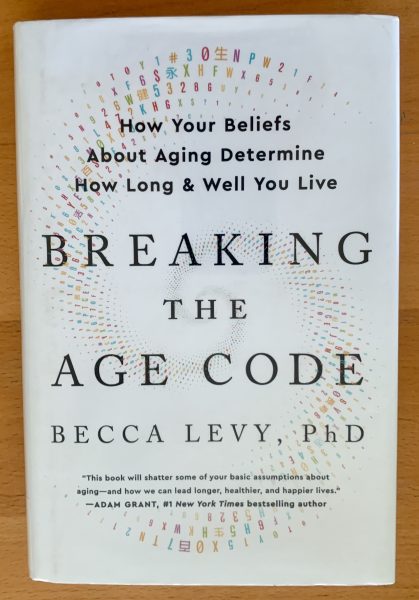
Levy’s book is so uplifting and well-reasoned that I can’t help but paraphrase some of the negative age stereotypes she debunks:
- Elders are less teachable: For as long as we challenge ourselves, our brains experience improved recall and the growth of new neurons.
- Most older persons experience dementia: Only about 3.6% of US adults age 65 to 75 have dementia, and there’s evidence that percentage is declining.
- Biology is all that matters: Positive age beliefs are powerful determinants of good health, whereas negative beliefs do the opposite.
- Elders injure easily, so they must avoid exercise: In fact, the World Health Organization notes that at any age, regularly exercise benefits us in all ways.
- Most seniors are untreatably mentally ill: Studies show that most of us become happier! Depression, anxiety and substance abuse goes down, while psychotherapy and the like are helpful at any age.
- Older workers are inferior: The truth is that older workers take fewer sick days and are superior in terms of experience, work ethics, creativity, and make teams work together more effectively.
- Older persons are drags on society: Nonsense, given how often older persons want to help create a legacy of a better world. They’re more likely to volunteer, recycle, and donate. More oldsters help out younger family members than vice versa.
- Old people aren’t as smart: Here’s what improves, especially if positive age beliefs are nurtured — metacognition (thinking about thinking). So does taking into account multiple perspectives, logic, and resolving social conflicts. Procedural memory, i.e., riding a bike, stays the same.
- They’re menaces behind the wheel: Findings show older drivers have few accidents, follow speed limits, buckle up, and don’t drive after drinking or while texting.
- They don’t have sex: 70% have romantic partners and most are sexually active.
- They lose creativity: Artists such as Henry Matisse only get better! Successful entrepreneurs are mostly over 50, and the elderly are innovative community leaders.
- Technology is beyond them: 3/4 of older people use social media regularly, 67% use the Internet, and 81% use smartphones. In her 70s, MIT professor Mildred Dresselhaus innovated the field of nano technology!
- Later life healthy changes are useless: Science shows that quitting smoking and reaching a healthy weight help us at any age.
- They can’t physically heal: At any age, people are likely to recover, especially if they’ve got positive age beliefs.
On a lighter note, more of our trip to Norway: Vik…
Vik and the surrounding region showcased the raw, untamed beauty of Norway, from ancient wooden churches to wintery mountain roads. Before we headed for Vik, a village across the Sognefjord from Bergen, we bussed to Forde Airport for a rental car. Early the next morning, we drove onto a ferry boat, then spent the day exploring Vik.
(Note: all posts about our visit to Norway are here and here and here and here and here and here and here and here and here and here and here and here and here.)
Hopperstad Stave Church has an impressive quality unlike any other church we’ve seen outside of Norway.
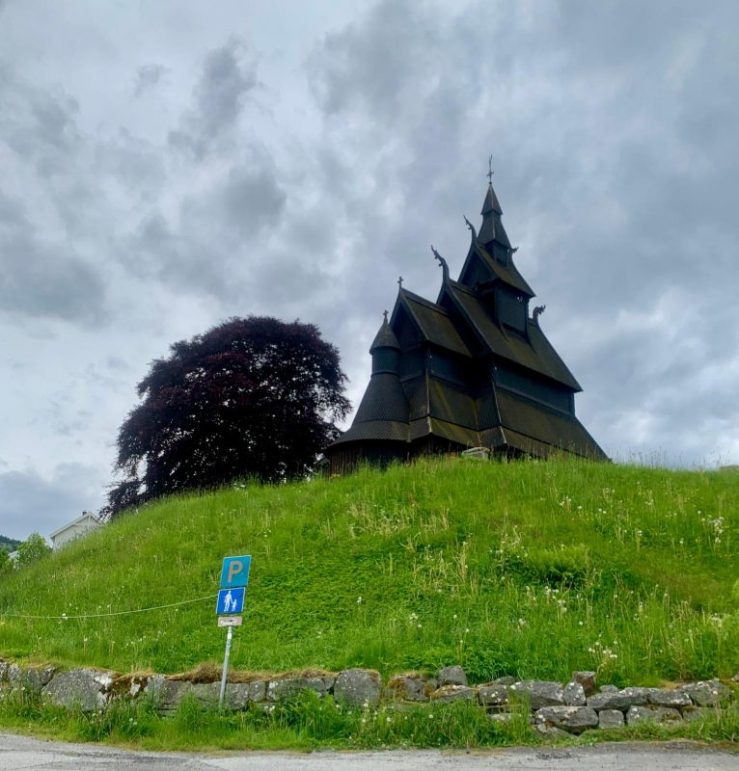
Driving further into the region, we took the aptly named, “Snow Road” route. Gone was the endless green we’d seen all over Norway up until then. The land pristine and remote, the water was still frozen in May.
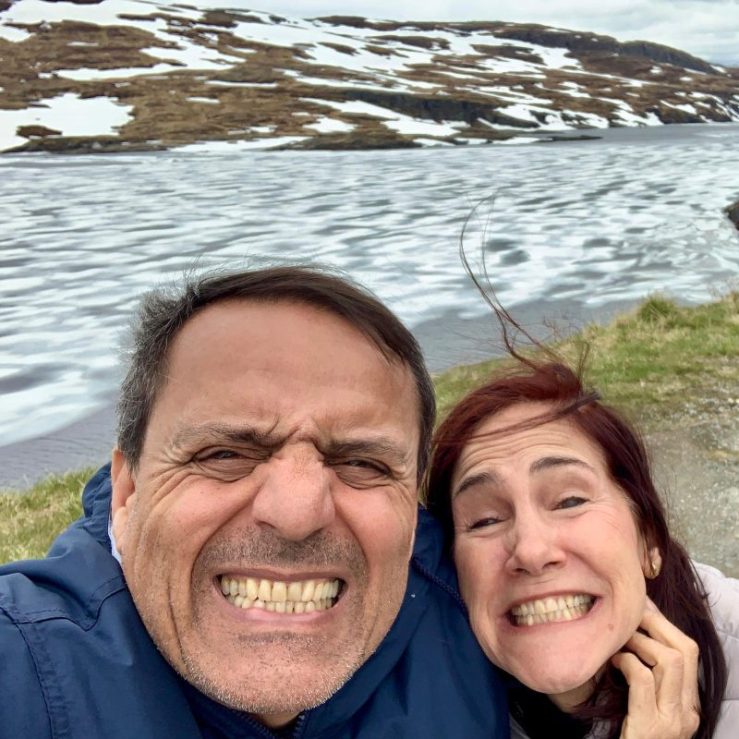
Buses and trucks shared the one-lane mountain road. So many Norwegian words sound similar to English, but are spelled differently that at times I had trouble remembering whether to write “bus” or “buss.” Every journey between cities seemed to include stone tunnels, one of them fifteen miles long with another long one appearing only a minute later.
After Snow Road came serpentine routes, waterfalls, and farmhouses amid expanses of flowers and grasses so vivid they rivaled instagram filters.



I doubt I’ll ever see as impressive a lookout as Stegastein Viewpoint, located on the Aurlandsfjellet National Tourist Route. The Aurlandsfjellet Scenic Route connects the Sognefjord area (near Balestrand/Vik) with the Aurlandsfjord/Flåm area.


Today’s guest blog post…
I’m thrilled to introduce you to Nurse Will from Wearing Two Gowns blog. His perspective, as both a healthcare professional and a father, offers a practical wisdom that can be incredibly helpful. Nurse Will started blogging as, “A way to integrate the emotional and executive parts of my brain.” He stresses that all of his posts, including his guest blog post that follows, are for educational purposes only. Here some of what he’s learned as a father…

When Your Child Forgets the Bus Again: A Father’s Guide to What Actually Works by Nurse Will a.k.a. Wearing Two Gowns
Fundamental strategies from the trenches of parenting children with ADHD and autism. Evidence-based and tested on Tuesday afternoons when everything falls apart.
Before I talk about my son, I want to mention my own journey. I have an official ADHD diagnosis and relate to the struggle with both hyperfocus and having to move to prevent inattention. I see these same patterns in my son, who also has ADHD and autism. Now, let’s talk about what works for us.
It was 3:47 PM on a Tuesday.
I got the call from the school: “Your son missed the bus again. He’s in the office.”
Again.
This wasn’t defiance. This wasn’t him being lazy or not caring. My 7-year-old with ADHD and autism… forgot. The bus left at 3:30. We’d talked about it that morning. But at 3:30, while other kids were lining up, he was deep in his own world, arranging his colored pencils by shade, thinking about what cool dinosaur he was going to be designing on his way home; utterly unaware that time was passing without him. He has to get home first before he can start that wonderful drawing.
Maybe it’s the bus. Perhaps it’s the art club they begged to join. Your child isn’t being difficult—their brain works differently.
And you’re tired. Tired of the phone calls, the guilt, and the feeling of failing despite how hard you fight. I see you, and I want to share what’s working for us, hoping it helps you too.
Why This Keeps Happening (And Why It’s Not Your Fault)
Here’s what I didn’t understand until I started digging into the research: my child isn’t forgetting because he doesn’t care. He’s forgetting because of something called executive function—the brain’s control center that helps us plan, organize, remember, and control our behavior.
Think of executive function like the manager of a restaurant, keeping track of every order. For kids with ADHD and autism, the manager is often overwhelmed, distracted, or just not showing up for work.
The specific struggle is with working memory—the ability to hold information in your mind long enough to use it. It’s like trying to carry water in your hands instead of a cup. By the time they get where they’re going, it’s all leaked out.
That’s when I realized: his brain isn’t broken. It’s just wired differently. And different wiring needs different support. Research confirms that many children with autism have strong visual-spatial memory. They remember pictures and images far better than words. That’s where our hope begins.
Practical Strategies That Actually Work
I’m not an expert. I’m a dad trying to figure this out one day at a time. These strategies aren’t theory. They’re what’s keeping us sane on Tuesday afternoons.
1. Visual Schedules: Making the Invisible Visible
A visual schedule is simply a set of pictures showing what happens when. When my son can see that the art club comes before the bus, he has something concrete to hold onto.
We use a simple board with velcro dots. Each morning, we put up pictures for the day. The key: he removes each picture as he completes it. It’s interactive, satisfying, and when he sees that red-bordered art club picture still there, something clicks.
2. Visual Timers: Making Time Something You Can See
Time is invisible to my son. “The bus leaves soon” means nothing because “soon” is an abstract concept. Visual timers change everything. We use a Time Timer—a clock with a red disk that shrinks as time passes. When I say, “You have 10 minutes,” he can see those minutes disappearing. It makes time concrete and manageable.
3. Simple Checklists: Because Memory Is Hard
I laminated a simple checklist and attached it to his backpack with a dry-erase marker.
- Look at the schedule
- Art club today?
- Pack backpack
- Walk to the bus area?
- This offloads the “remembering” from his brain onto the card.
4. Break It Down: Tiny Steps for Big Tasks
“Get ready for the bus” is way too big. It’s ten different tasks hidden inside one instruction. So we break it down:
- Stop playing.
- Walk to the backpack.
- Could you put the folder in? Put the lunchbox in.
- Zip backpack.
- Walk to the bus line.
- Ten steps. Each one is simple enough that he can do it without getting overwhelmed.
5. Predictable Routines and Rewards
Predictability is security. Our after-school routine is identical every single day. Same time. Same sequence. Same words. This reduces anxiety and builds muscle memory.
We also use rewards. When my son successfully catches the bus five times, he earns extra screen time. But more important is the immediate praise. “You looked at your schedule without me reminding you! That’s awesome!” Specific, immediate, and genuine praise reinforces the effort, not just the result.
A Final Thought
These strategies don’t work every time. Some days, he still forgets. Executive function skills are affected by sleep, hunger, and stress. A child who is successful Monday through Thursday might forget on Friday because they’re exhausted.
That’s not regression. That’s being human.
Your child can learn to remember. It won’t look the same as other kids. It won’t happen as fast as you hope. But with the right support and consistent routines, they will get there. Three months ago, my son missed the bus 3-4 times a week. Last week, he caught it every single day.
Progress isn’t linear. But it’s still progress. Keep going.
— A Father Still Learning
Which of Becca Levy’s age myths surprised you the most, or what is your family’s best executive function hack? Let us know in the comments!
Discover more from Happiness Between Tales (and Tails) by da-AL
Subscribe to get the latest posts sent to your email.


Thanks for the share – that church looks amazing (and I’ll track down the book – it sounds good too!) Merry Christmas, warm regards, Linda 🤶❤️
LikeLiked by 1 person
same to you, Linda!
LikeLiked by 1 person
❤️🤶🌟🎄💚
LikeLiked by 1 person
Dear Da-AL,You shared some really interesting facts about aging
LikeLiked by 1 person
glad you liked it!
LikeLike
Wonderful, encouraging information about aging, and I can verify that I’m seeing and feeling much of that in my own life and in the lives of my friends. I just wish our society saw it, too. Norway—oh my goodness! I would be in heaven! And the practical advice from a parent about ways to help his son is so important and I will share it with my family. Thank you for a wonderful post! ❤️
LikeLiked by 1 person
thank you, Lori!
LikeLiked by 1 person
[…] Guest Post […]
LikeLiked by 1 person
thank you for linking!
LikeLike
Hi, Daal,
all the statement about the elderly are nonsense in my eyes, but the most nonsensical must be that old people are not that smart. I mean, scientists and professors among others get old too, will they suddenly get stupid? hahaha
You look freezing on that photo from Norway, but what a landscape, so beautyful. When I saw the winding road, I was just thinking “motorbike”. ❤
I liked the advice of the young father. Sometimes the experiences from real life are more useful for others than all the psychology books. I have an ADD husband … 😉 … luckily he has learned to organize himself.
LikeLiked by 2 people
motorbike would be even more freezing lolo tx for stopping by, Birgit
LikeLiked by 1 person