
The Writer’s Corner: My Test with AI for Pitches and Blurbs
Welcome back! Before we continue our scenic tour of Norway, I want to jump straight into a controversial topic that’s been dominating the publishing world: Artificial Intelligence. Have you used AI for writing, particularly for novels and self-publishing? If so, which one? Feel free to hate on me, but as I continue to study how best to self-publish my novels in such a way that more people will buy them than my immediate circle of family and friends, I’m more than a little intrigued. So far, the minor tests I’ve run with Gemini prove it’s amazing for helping fine-tune elevator pitches, blurbs, and the like.

Norway: That Oh, So Enviable Calm
Now it’s time to continue our springtime tour of Norway!
(Note: all posts about our visit to Norway are here and here and here and here and here and here and here and here and here and here and here and here and here and here and here.)
Sure, I looked at Norway through the eyes of a Los Angeles vacationer, an escapee of the horrors of the recent out-of-control urban wildfires and the nightmare political situation that’s gone from bad to ever worse.
Seriously, though, I dare you to try and not love Norway’s treasure trove of social justices and eye-popping beauty… I don’t know whether it had to do with their amazing all-embracing healthcare system and non-Hollywood definition of beauty (and for that matter, success), but the rare times that I turned on a TV, the commercials entranced me. Why? Because none hocked anti-wrinkle miracles, incontinence, male virility, dentists, and charities for veterans and ailing kids. Banks, groceries, and the occasional lipstick were about it.
But I digress… From Stavanger, we woke early for quick breakfast and packing, then we boarded a bus for Bergen!
Bound for Bergen
The bus drive included many long tunnels carved into rock. The bus had Wi-Fi, and was comfy, clean, and a bathroom smaller than the kinds on airplanes. Among the beauty we passed were green farms with sheep, cows, and horses. Lots of small towns. And always waterways and bridges over them.
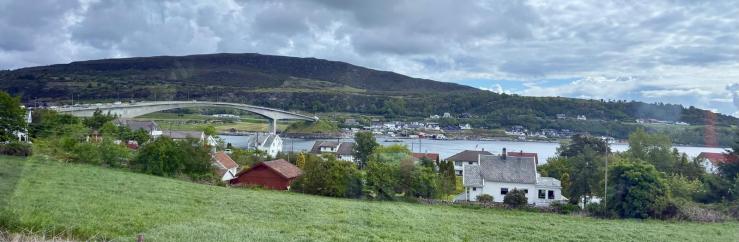
The bus also took us aboard two ferry boats, also neat and clean, and with full-on cafeterias.

Once the bus arrived to Bergen, we walked toward our hotel (hurrah for never doing anything but carryon backpacks). Along the way, we happened onto an ongoing music festival. We later learned that Norway is famous for lots of free outdoor music events.
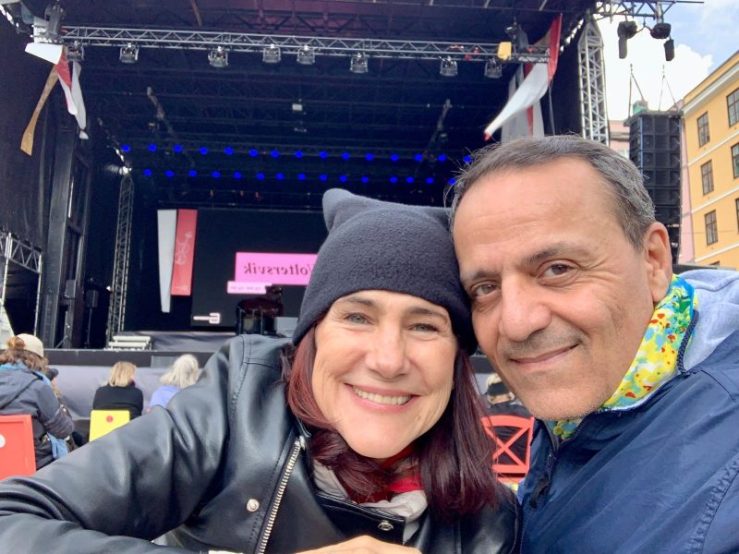
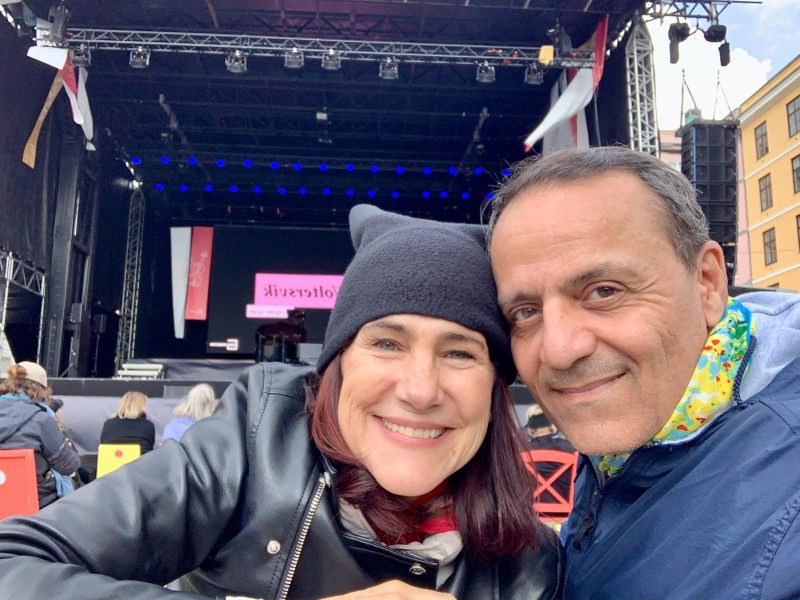
Pianist Oda Voltersvik, performing classical/neo-classical/Nordic female composers, was so cold that she kept a heater nearby and donned mittens between pieces. This video includes a 360 degree pan of area…
After we settled into our hotel, we went back to hear Sjøforsvarets musikkorps — The Royal Norwegian Naval Forces Band (a professional military band), which excels at classical, pop, jazz, and contemporary music.
Afterwards, we found a great Italian restaurant that, typical of Norway, was delicious and pricey. We walked home in rain, eager to rest up to explore more of Bergen, which you’ll see in my next post!
Guest Post: Bringing Queen Matilda of Boulogne out of History’s Shadows
Now for a deep dive into the craft of historical fiction! I’m thrilled to welcome back Valeska Réon, who, along with her writing partner Nicolai Tegeler, is tackling the life of a forgotten English Queen. For anyone interested in detailed historical research and novel structure, this is a must-read.”

“Requiem for a Queen” by Valeska Réon and Nicolai Tegeler, as recounted by Valeska Réon
Nicolai Tegeler, a screenwriter and director, and I had already written two thrillers together when we decided: Let’s write a historical novel!
We then set out in search of a medieval figure and came across the English queen Matilda of Boulogne. What immediately intrigued us was that there wasn’t a single book that told her life story the way she deserved.
Born in 1105 in Boulogne-sur-Mer, she married Stephen, Count of Mortain, in 1125 and was crowned Queen of England on March 22, 1136. Those were the known facts.
But Nicolai and I wondered: What did she do before her marriage? And what happened afterwards?
That’s where things got exciting.
First, we brought on board THE leading expert on Queen Matilda: Professor Dr. Amalie Fößel from the University of Duisburg-Essen. Through her, we gained access to academic papers and previously unpublished historical records. We also conducted genealogical research into both Matilda’s and Stephen’s families. As we pieced together all the facts, Matilda’s childhood unfolded before our eyes, allowing us to bring her to life for our readers in vivid detail.
We paid special attention to Matilda’s role during the Anarchy (1135–1153). Her husband was captured and imprisoned by his rival, Empress Maud. And this is where Matilda’s bravery shines through: Together with the Flemish mercenary leader William of Ypres, she led the army to free Stephen.

At this point in our story, we took a literary liberty – we amplified and dramatized the rumors about the relationship between Stephen and Maud, which leads Matilda to… Well, we won’t give away the ending, but let’s just say: In a clever metafictional twist, we also follow Mélanie Moreau, a modern-day writer who – after discovering the absence of any major work on Matilda – sets out to tell her tale. This parallel narrative weaves past and present together, celebrating the enduring power of storytelling itself.
Matilda has long been relegated to the footnotes of history, remembered – if at all – as merely the appendage to her husband. With our novel we want to rescue this remarkable woman from obscurity and place her where she belongs: at the centre of her own legend.
All in all, it took us two years to finish the book – but we couldn’t be happier that we took on the extensive research and sometimes grueling writing process.

What we find especially exciting is that, unlike our previous books, this one wasn’t published in our home country of Germany, but in England. However, Nicolai and I have already translated the manuscript into French. Since Matilda was French by birth and most of the story takes place in France, we believe our book will also resonate with French readers.
Our next novel is already in the works, another historical novel with a special twist. This time, King Richard the Lionheart, the alchemist Michael Scotus, and – in a parallel storyline set in the present day – the prickly chemist Delphine cross paths as she investigates the mystery of Richard’s heart in Rouen Cathedral.
If you had to choose one: Where do you draw the line with using AI in your writing process (marketing, outlining, editing, etc.)?
Discover more from Happiness Between Tales (and Tails) by da-AL
Subscribe to get the latest posts sent to your email.


[…] (Note: all posts about our visit to Norway are here and here and here and here and here and here and here and here and here and here and here and here.) […]
LikeLiked by 1 person
[…] about our visit to Norway are here and here and here and here and here and here and here and here and here and here and here and […]
LikeLiked by 1 person
[…] (Note: all posts about our visit to Norway are here and here and here and here and here and here and here and here and here and here and here.) […]
LikeLiked by 1 person
[…] about our visit to Norway are here and here and here and here and here and here and here and here and here and here and […]
LikeLiked by 1 person
Great couple 😊😊.
LikeLike
blushing lol
LikeLiked by 1 person
☺️☺️ hav fun dear .
LikeLiked by 1 person